DATABASE_ARCHIVE // DIRECT_LINK
[ THE WIRETAP ]
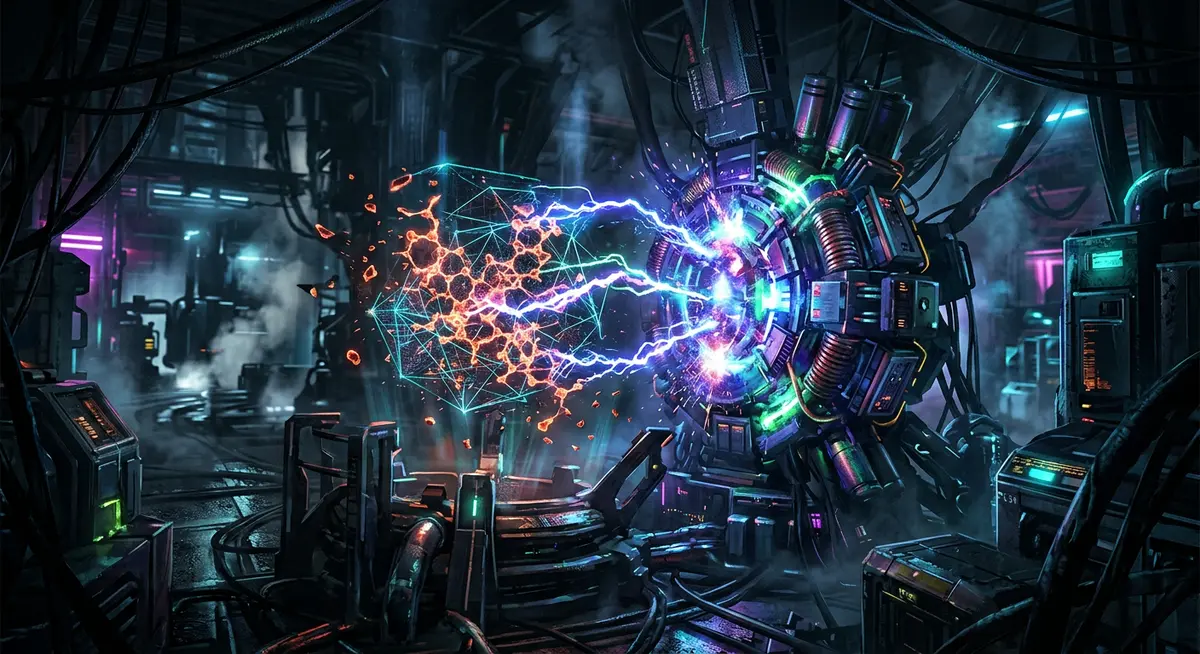
An unlikely alliance between quantum rivals is leveraging quantum data to train AI, aiming to break the computational deadlock in chemical systems and accelerate material and drug discovery.
[ THE DISPATCH ]
The intel stream reveals a joint operation from IonQ's Chi Chen and Microsoft's Matthias Troyer, two operators typically on opposing sides of the quantum grid. Their target: the "Jacob's Ladder" protocol, a long-standing choke point in chemistry simulations where the true behavior of electrons in molecules becomes an exponential computational wall. Standard processing rigs hit a hard limit, unable to untangle the intricate, multi-state interactions crucial for designing advanced catalysts or next-gen power cells. This isn't theoretical; it's a hard-target problem, slowing down breakthroughs across multiple sectors.
Their tactical blueprint is a hybrid maneuver. Current quantum hardware remains raw, but its core qubits possess the capacity to map these complex electron configurations with pinpoint precision, generating small batches of high-fidelity data—intel too resource-intensive for conventional systems to compute directly. This isn't about quantum taking the full operational load; it's about providing surgical-grade data packets. This quantum-sourced intel then trains classical AI models, allowing them to rapidly generate accurate predictions, bypassing the arduous, multi-stage climb of traditional simulation methods. We've seen a glimpse of this speed even with conventional AI, as demonstrated by the Pacific Northwest National Lab's rapid screening of 32 million battery electrolyte candidates, collapsing decades of analysis into weeks. Quantum accuracy is poised to supercharge that entire intel pipeline, delivering predictive power previously unattainable.
This strategic fusion effectively bends the rules of the "Jacob's Ladder" protocol. It grants analysts on standard workstations access to a level of predictive accuracy once locked behind an 'exponential wall.' We're talking granular insights into reaction pathways, energy barriers—the kind of mission-critical intelligence that dictates drug efficacy, battery longevity, or the breakdown of persistent pollutants. Small miscalculations here can send entire development cycles off-mission, wasting years and billions. This isn't just about processing speed; it's about reliable, high-resolution intel where the stakes are measured in global impact and technological supremacy.
[ THE CASUALTIES ]
Quantum Data Feeds AI: Cracking Molecular Code
<< RETURN_TO_MAIN_CONSOLE
ORIGIN: 2026-03-08 14:26:55
NODE: GHOST_COMMAND // AI_SYNTHESIS
[ THE WIRETAP ]
An unlikely alliance between quantum rivals is leveraging quantum data to train AI, aiming to break the computational deadlock in chemical systems and accelerate material and drug discovery.
[ THE DISPATCH ]
The intel stream reveals a joint operation from IonQ's Chi Chen and Microsoft's Matthias Troyer, two operators typically on opposing sides of the quantum grid. Their target: the "Jacob's Ladder" protocol, a long-standing choke point in chemistry simulations where the true behavior of electrons in molecules becomes an exponential computational wall. Standard processing rigs hit a hard limit, unable to untangle the intricate, multi-state interactions crucial for designing advanced catalysts or next-gen power cells. This isn't theoretical; it's a hard-target problem, slowing down breakthroughs across multiple sectors.
Their tactical blueprint is a hybrid maneuver. Current quantum hardware remains raw, but its core qubits possess the capacity to map these complex electron configurations with pinpoint precision, generating small batches of high-fidelity data—intel too resource-intensive for conventional systems to compute directly. This isn't about quantum taking the full operational load; it's about providing surgical-grade data packets. This quantum-sourced intel then trains classical AI models, allowing them to rapidly generate accurate predictions, bypassing the arduous, multi-stage climb of traditional simulation methods. We've seen a glimpse of this speed even with conventional AI, as demonstrated by the Pacific Northwest National Lab's rapid screening of 32 million battery electrolyte candidates, collapsing decades of analysis into weeks. Quantum accuracy is poised to supercharge that entire intel pipeline, delivering predictive power previously unattainable.
This strategic fusion effectively bends the rules of the "Jacob's Ladder" protocol. It grants analysts on standard workstations access to a level of predictive accuracy once locked behind an 'exponential wall.' We're talking granular insights into reaction pathways, energy barriers—the kind of mission-critical intelligence that dictates drug efficacy, battery longevity, or the breakdown of persistent pollutants. Small miscalculations here can send entire development cycles off-mission, wasting years and billions. This isn't just about processing speed; it's about reliable, high-resolution intel where the stakes are measured in global impact and technological supremacy.
[ THE CASUALTIES ]
- Materials Discovery: Protracted development cycles, flawed material designs, resource waste.
- Drug Development: Slowed research, higher costs, delayed market entry for critical medicines.
- Energy Sector: Inefficient battery designs, suboptimal catalyst performance, increased R&D expenditure.
- Environmental Chemistry: Limited understanding of pollutant degradation, inefficient remediation strategies.